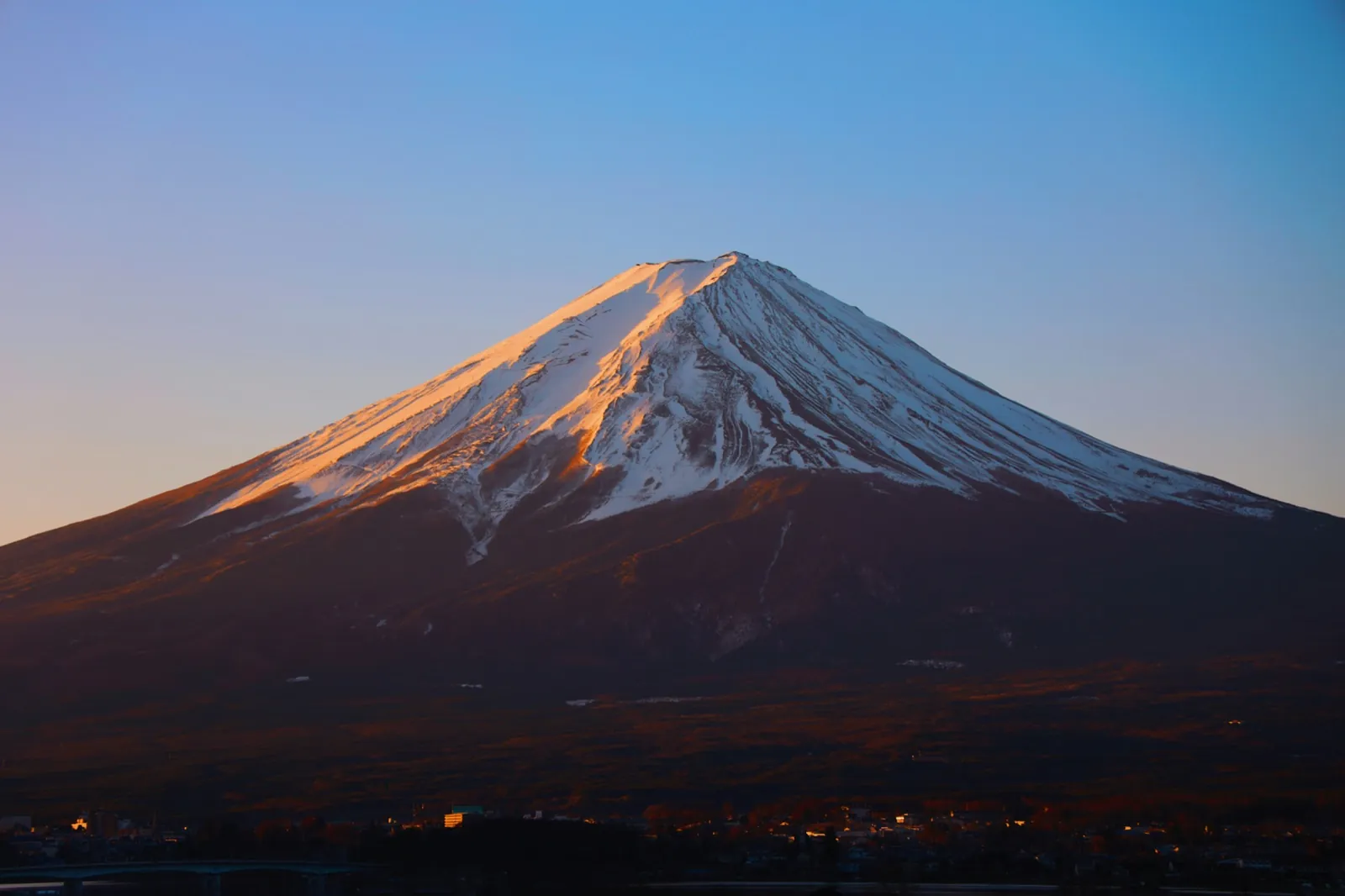
Mount Fuji with its snow-capped summit tinged red at dawn, above a town at its foot

Seeing Mount Fuji from Tokyo

How to get to Kawaguchiko, the best viewpoints and when it is seen clear.

Mount Fuji is the most sought-after trip from Tokyo, and rightly so: the image of the perfect volcano reflected in a lake is one of the symbols of Japan. In this guide you will see where Fuji can be seen (even from Tokyo itself on clear days), how to get to the Five Lakes region and Kawaguchiko, which are the best viewpoints, when you have the best chance of seeing it clear and how many days are worth giving it. And, if what you want is to climb to the summit, the up-to-date dates and rules of the climbing season.

Where Mount Fuji can be seen

Before organising the trip it is worth knowing that Fuji is elusive: it is about 100 km from Tokyo and, although it stands 3,776 metres tall, it spends much of the year hidden among clouds and haze. Seeing it well depends as much on where you go as on the season and the hour.

On a really clear day, Fuji can be seen even from Tokyo itself: from the observation decks of the Tokyo Skytree or from the (free) platforms of the Tokyo Metropolitan Government Building in Shinjuku. It is a distant, beautiful view, but it is not the classic postcard.

For that postcard — the whole volcano reflected in the water — you have to get close to its base, to the Fuji Five Lakes region. The most accessible and best connected with Tokyo is Lake Kawaguchi (Kawaguchiko), which has become the usual base for this trip. The other great option for seeing Fuji with a good connection from Tokyo is Hakone, with its own access and its own charm: we cover it as an alternative below.

How to get to Kawaguchiko from Tokyo

Kawaguchiko is about two hours from Tokyo and is well reached by train, bus or an organised tour. These are the three ways, with their advantages:

OptionHow it worksFor
Direct train (Fuji Excursion)Direct limited express train Shinjuku → Fujikawaguchiko, about 2 h. No transfers needed.Convenient, no transfers, you arrive in central Kawaguchiko.
Train with a transfer at OtsukiTrain from Shinjuku to Otsuki and there you change to the private Fujikyu line to Kawaguchiko.More departures throughout the day; the Shinjuku–Otsuki leg is covered by the Japan Rail Pass.
Direct bus (Busta Shinjuku)Fujikyu bus from the Busta Shinjuku terminal (south exit) to Kawaguchiko, about 1 h 45 min, for around 2,000–2,200 yen each way.Usually the cheapest option; it drops you at Kawaguchiko station.
Organised day tourDeparture from Tokyo with transport, stops at the viewpoints and sometimes Hakone included, returning the same day.Zero logistics: ideal if you are short on time or do not want to organise trains.
The leg between Otsuki and Kawaguchiko runs on the Fujikyu line, which is private and not included in the Japan Rail Pass: that leg is paid separately. Departures and timetables change by season; check the up-to-date timetable before fixing your day.

Day tour · Klook

Full-day guided tour to Mount Fuji from Tokyo

Departure from Shinjuku with transport and stops at Fuji's most famous viewpoints; you return to Tokyo the same day with no trains to organise. Rated 4.9 out of 5 with more than 2,000 bookings.

View the tour on Klook

Affiliate link: if you book through it you pay nothing extra and you help keep this site running.

The best Fuji viewpoints in Kawaguchiko

Once in the area, these are the points where the view of Fuji is most spectacular. Almost all are around Lake Kawaguchi and in neighbouring Fujiyoshida, and they combine well in a day if you organise yourself:

  • Chureito Pagoda (Arakurayama Sengen): the most iconic viewpoint. A red five-storey pagoda with Fuji in the background, in Fujiyoshida. You climb a staircase of almost 400 steps to the viewpoint. Spectacular with cherry blossoms in April and red maples in autumn.
  • Oishi Park: on the north shore of Lake Kawaguchi, with Fuji reflected in the water and beds of seasonal flowers in the foreground. It is one of the most photographed framings in the area.
  • Tenku-no-Torii (Kawaguchi Asama shrine): the so-called "torii of the sky", a red gate up high from which Fuji appears framed. There is a good climb on foot from the shrine to the viewpoint.
  • The Kawaguchiko Lawson: the famous konbini whose blue facade was aligned with Fuji and went viral. It is still a stop, but bear in mind the warning below: the overcrowding forced barriers to be put up.

For most travellers, the winning combination is Chureito Pagoda early in the morning (better light and fewer people) and Oishi Park for the view over the lake. This is where an organised tour or a local sightseeing bus saves you a lot of time between points.

The viral Lawson: what is happening now

The Fujikawaguchiko Lawson became world-famous because its blue facade was perfectly aligned with Fuji. The flood of tourists — people crossing the road without looking, litter, badly parked cars — led the town council to install in 2024 a black screen of about 20 metres to block the view. That screen was temporarily removed and, in August 2025, replaced by a lower barrier (around 1.4 m) that prevents crossing the road but allows the photo.

In short: the spot still exists and can be photographed, but it is no longer the original clean shot and the council may tighten the measures again if the chaos returns. Do not devote a whole trip to it: it is an anecdotal stop, not the reason for the day. The viewpoints in the previous section give far better views.

Golden rule throughout the area: respect the pedestrian crossings, do not cross or stop on the road for the photo and do not block accesses. Much of the restrictions exist precisely because of the bad behaviour of some visitors.

When Fuji is seen clear

This is the key question, because you can do the whole trip and find Fuji wrapped in clouds. The probability of seeing it clear depends a lot on the season and the time of day.

Best time: winter

The cold, dry air of winter leaves the sky much cleaner. From December to February is when Fuji is seen clear most often (February is usually the best month), while in summer the humidity and the rainy season hide it almost always. Over the year, it is estimated that Fuji is only seen clearly around 80 days, concentrated above all in the cold months. The trade-off is that in winter it is genuinely cold in the area and the lakes are beautiful but freezing.

Best hour: early morning

Almost regardless of the season, early in the morning (around 6:00–8:00) the air is colder and cleaner and there are fewer clouds: it is when you have the best chance of seeing the whole volcano. As the day goes on, the heat generates haze and clouds that tend to cover the summit. If you can, organise the trip to be at the viewpoints early, or sleep a night in the area to wake up there.

How many days to give it: one day or two-three

There are two ways to approach it, depending on how much time you have:

  • One day (express): you leave Tokyo early, visit a couple of viewpoints (Chureito and Oishi Park, for example) and return to sleep in Tokyo. It is the most common and fits perfectly as a day trip. The risk is the weather: if Fuji is covered that specific day, you miss the postcard.
  • Two or three days (with a night in the area): you sleep in Kawaguchiko or nearby. This way you can wake up by the lake — the best time to see Fuji — you have a margin if the first day is cloudy and you have time for more viewpoints, the onsen with views or even Fuji-Q Highland. It is the option we recommend if Fuji is a real priority of your trip.

If your itinerary is tight and you already pass through the area on the way between Tokyo and Kyoto, consider doing Fuji as a stop rather than a there-and-back, splitting the nights between cities according to your route and pace to see if a night near Fuji fits.

Alternatives: Hakone and Gotemba

Kawaguchiko is not the only way to see Fuji from Tokyo:

  • Hakone: a mountain and onsen area very well connected with Tokyo, with its own access (the well-known mountain train, funicular, cable car and lake-Ashi boat loop). Fuji can be seen from several points, especially from Lake Ashi and the cable car, and it also offers hot springs and museums. It is a perfect alternative or complement: it has its own guide on the site.
  • Gotemba: on the south-eastern slope of Fuji, known above all for its large shopping outlet with the volcano in the background. It works well combined with a tour, more than as a viewing destination in itself.

If you are torn between Kawaguchiko and Hakone: Kawaguchiko gives the most "postcard" views of Fuji over the lake and the photographic viewpoints; Hakone adds onsen, nature and a very entertaining circular route. If you have time, they are not mutually exclusive.

Climbing to the summit: season and up-to-date rules

Seeing Fuji and climbing Fuji are two completely different plans. The climbing season is very short and only then are the trails open and the huts operating. Outside it, climbing is dangerous and strongly discouraged. In recent years the rules have changed quite a bit to curb overcrowding, so it is worth being clear on them.

2026 season (indicative)

  • The Yoshida route (the most popular, on the Yamanashi/Kawaguchiko side) and the Subashiri route are expected to open on 1 July; the Fujinomiya and Gotemba routes, around 10 July. All close around 10 September.
  • On the Yoshida route a climbing fee of 4,000 yen per person is charged to pass the fifth-station gate, which must be booked and paid in advance online. The stretch from the base to the fifth station is exempt.
  • There is a cap of 4,000 people a day on the Yoshida route, split into around 3,000 places with advance booking and about 1,000 available on the day. The cap does not apply to those with a mountain-hut reservation.
  • To prevent the dangerous "bullet climb", the trail gates close at night (around 14:00–3:00); only those with a hut reservation pass.
  • The fee does not include the mountain hut: the accommodation is booked and paid separately.
These dates, fees and caps are the ones announced for 2026 and may be adjusted each season. Before planning a climb, check the official Fuji climbing website to confirm exact dates, the booking system and the rules in force that year. For the vast majority of travellers, what they are after is to see Fuji from below, not to climb it, and that can be done all year round.
Fit Mount Fuji into your route through Japan The planner automatically splits the nights between cities according to your pace and interests, and helps you see if a night near Fuji fits.
Plan my trip

More travel guides

Frequently asked questions

Can you see Mount Fuji from Tokyo?

Yes, but only on very clear days. From Tokyo itself it can be seen in the distance from viewpoints such as the Tokyo Skytree or the Tokyo Metropolitan Government Building (free) in Shinjuku. For the classic view of the volcano reflected in a lake you have to get close to the Five Lakes region, especially Kawaguchiko.

How do you get to Mount Fuji from Tokyo?

Kawaguchiko is reached in about 2 hours: with the direct Fuji Excursion train from Shinjuku, with a train to Otsuki and a transfer to the private Fujikyu line, or by direct bus from the Busta Shinjuku terminal (usually the cheapest). There are also organised day tours from Tokyo. Check the up-to-date timetables before going and note that the Fujikyu line is not included in the Japan Rail Pass. More detail in the transport in Japan guide.

What is the best viewpoint of Mount Fuji?

In the Kawaguchiko area, the most spectacular are the Chureito Pagoda (Arakurayama Sengen), with its red pagoda and Fuji in the background; Oishi Park, on the north shore of Lake Kawaguchi; and the Tenku-no-Torii of the Kawaguchi Asama shrine. The usual combination is Chureito early on and Oishi Park for the view over the lake.

When is Mount Fuji seen clear?

In winter (December to February, with February as the best month), because the cold, dry air leaves the sky clear; in summer it is usually covered. At any time, the best hour is early in the morning, around 6:00–8:00, before the heat generates clouds. It is estimated that Fuji is only seen clearly about 80 days a year.

How many days to give to Mount Fuji?

It can be done in a day as a trip from Tokyo, visiting a couple of viewpoints and returning to sleep in the city. If Fuji is a priority, two or three days with a night in Kawaguchiko is better: that way you wake up by the lake (the best time to see it) and have a margin if the first day is cloudy.

Does the Fuji Lawson spot still exist?

Yes, but with caveats. The black screen that blocked the view in 2024 was replaced in August 2025 by a lower barrier (about 1.4 m) that prevents crossing the road but allows the photo. It is no longer the original clean shot and is just an anecdotal stop: viewpoints such as Chureito or Oishi Park give far better views. Always respect the pedestrian crossings and do not stop on the road.

When can you climb Mount Fuji?

Only during the short summer season. In 2026, the Yoshida route is expected to open on 1 July and all routes close around 10 September. On the Yoshida route you must book and pay a 4,000-yen fee in advance online, there is a cap of 4,000 people a day (about 3,000 with advance booking and 1,000 on the day) and the gates close at night to prevent the bullet climb. Always confirm dates and rules on the official website before planning the climb; to just see Fuji there is no need to climb.

Better Kawaguchiko or Hakone to see Fuji?

Kawaguchiko gives the most postcard-like views of Fuji over the lake and the photographic viewpoints. Hakone adds onsen, nature and a circular route by mountain train, funicular, cable car and boat, with Fuji visible from Lake Ashi. If you have time, they are not mutually exclusive; if you only choose one, it depends on whether you prioritise the photo of the volcano (Kawaguchiko) or the mountain and hot-spring experience (Hakone).