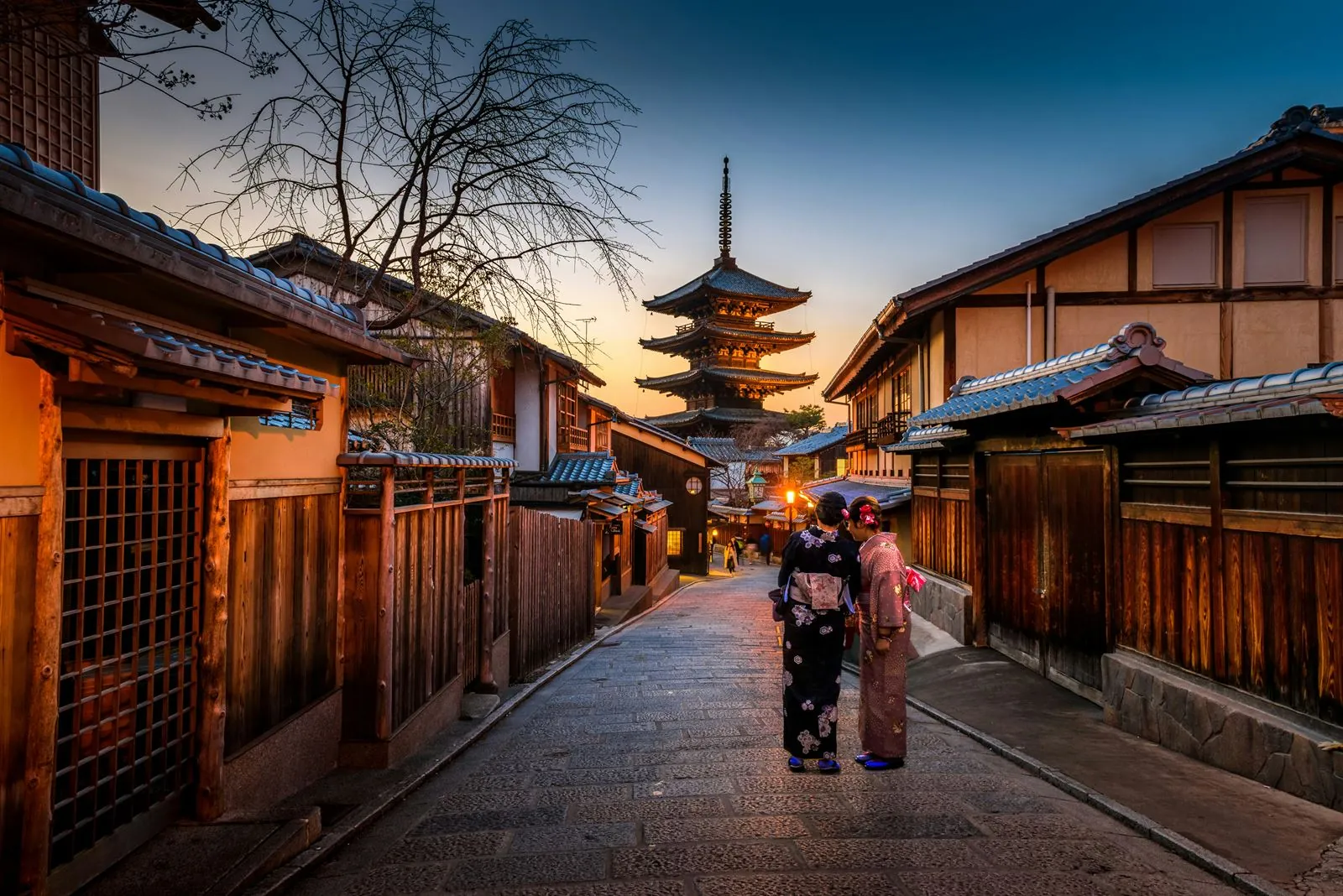
View of traditional temples and rooftops of Kyoto

How many days in Kyoto you need

From 2 to 5 days: what each option gives you and how to make the most of the most visited city in Japan.

Kyoto gathers more than 1,600 Buddhist temples, hundreds of Shinto shrines and 17 World Heritage monuments. It cannot be exhausted in a week. But most travellers give it between 2 and 5 days, and with discernment that is enough for a memorable experience. How many days you need in Kyoto depends above all on whether it is your first visit and on how many day trips you want to chain together.

2 days in Kyoto: the sensible minimum

With 2 days you can see the most iconic spots if you are selective. The key is not to try to cover the whole city: Kyoto has very spread-out areas and moving between them takes time.

  • Day 1 — historic east: Fushimi Inari at dawn (arrive before 8:00), then the Gion district and the Higashiyama path. Kiyomizudera temple at dusk.
  • Day 2 — northwest: Arashiyama in the morning (bamboo grove, Tenryu-ji temple, riverside walk). In the afternoon, Kinkaku-ji temple (the Golden Pavilion) and the Ryoan-ji gardens.

What you will not have time for: the Nishiki district, Nijo-jo, the secondary temples of the north, a trip to Nara. With 2 days you have to give up quite a lot.

3 days: the recommended minimum for a first visit

3 days is the time that lets you see Kyoto without the feeling of rushing. You can spread out the areas more calmly and add some detail that 2 days leaves out.

  • Day 1: Fushimi Inari + the Gion district at dusk.
  • Day 2: Arashiyama (bamboo, Tenryu-ji, Saga-Toriimoto) + Kinkaku-ji.
  • Day 3: Higashiyama in full (Kiyomizudera, Ninenzaka, Sannenzaka, Maruyama) + Nishiki Market.

With 3 days you can also include half a day in Nara if you do not have it elsewhere in your itinerary: it is about 45 minutes by train (JR Nara Line) or 35 minutes on the Kintetsu.

4–5 days: with time to go beyond the circuits

With 4–5 days you can see everything above and add what separates travellers who know Kyoto from those who have only visited it: the less crowded temples of the north (Kurama, Kibune), the Nishiki district and the everyday market, the Imperial Palace and Nijo-jo.

It is also enough time to do Nara as a comfortable day trip (a full day) and still have days for Kyoto.

5 days also lets you adjust the pace: mornings at the temples before the crowds, afternoons exploring the less touristy Kyoto — Shimogamo, the Fushimi district beyond the shrine, the Nishijin craft shops.

How many days by traveller profile

  • First time in Japan, combined trip: 3 days (3 nights). It is the usual allocation in a 10-14 day itinerary with Tokyo and Osaka.
  • First time with Kyoto as the star: 4 days, to include Nara as a day trip without sacrificing the historic centre.
  • Fans of temples, photography or traditional culture: 5 days or more, to reach Kurama, Kibune, Ohara or the Uji tea fields.
  • Just passing through (Tokyo-Osaka loop): 2 well-planned days cover the most iconic spots, accepting some sacrifices.

If you are coming in cherry blossom or autumn season, add a margin: the crowds slow everything down. See when to visit Kyoto to choose your dates.

Kyoto within a trip through Japan

On a 10–14 day trip that includes Tokyo, Kyoto and Osaka, the usual thing is to allocate 3 nights to Kyoto. It is enough for a first visit if the pace is medium-high.

If you also include Hiroshima or Nara as a day trip from Kyoto, you need at least 4 nights — one of those days will be devoted to the trip and you will not be able to explore Kyoto that day.

A popular option: stay in Osaka and do Kyoto as a day trip (or vice versa). The Shinkansen takes only 15 minutes between the two cities. This strategy saves money if Kyoto hotels are more expensive, but it means losing the dawn hours at the temples and the Gion atmosphere at night.

To see how these 3–4 nights fit into the whole trip, look at the ready-made itineraries of 10 days and 14 days, where Kyoto already appears spread out alongside Tokyo and Osaka.

Summary: how many days for your case

DaysWho forWhat fitsWhat is left out
2 daysPass-through on a long tripFushimi Inari, Gion, Arashiyama, Kinkaku-jiHigashiyama, Nara, Nijo-jo, the north
3 daysFirst visit, combined tripAll the above + Higashiyama in fullNara, the northern temples, Nijo-jo
4 daysFull first visitEverything + Nara as a day tripNorthern Kyoto (Kurama, Kibune)
5 daysKyoto as the main destinationEverything + Nara + Nijo-jo + Nishijin + the northAlmost nothing essential

How to group the areas so you do not lose the day in transit

The most expensive mistake in Kyoto is not choosing the wrong temples: it is zigzagging across the city. The points of interest are spread out in areas far from each other, and bus traffic in high season is slow. The golden rule is to devote each half-day to a single area and chain together what is nearby.

  • East / Higashiyama: Kiyomizu-dera, Ninenzaka, Sannenzaka, Maruyama, Yasaka and the Gion district. It is explored entirely on foot in half a day.
  • South: Fushimi Inari (and, if you have time to spare, the Fushimi sake district). Well combined with Tofuku-ji, which is on the way.
  • Northwest: Arashiyama (bamboo grove, Tenryu-ji, riverside walk) in the morning and Kinkaku-ji + Ryoan-ji in the afternoon. The two areas connect by bus or train.
  • Centre: Nishiki Market, Nijo-jo and the Imperial Palace. Ideal for a rainy or hot half-day, almost all under cover or in the shade.
  • North: Kurama and Kibune. They are far away and eat up a whole day; save this only if you have 4–5 days.

If you chain together neighbouring areas instead of crossing the city, a 3-area day on a badly planned map becomes a calm day of 1–2 well-used areas. To get around between them, review how transport works in Japan.

Work out how many days in Kyoto fit your trip The planner splits the days between Kyoto and the rest of the cities to fit your budget.
Plan my trip

More travel guides

Frequently asked questions

Are 3 days in Kyoto enough?

For a first visit, yes. With 3 days you can see Fushimi Inari, Arashiyama, Gion and the Higashiyama district at a good pace. If you also want Nara or the northern temples (Kurama), you need a fourth day.

How many days of Kyoto are too many on a trip through Japan?

On a 2-week itinerary, more than 4 nights is usually excessive for a first visit. Osaka is about 15 minutes by Shinkansen, Nara 35-45 minutes, and there is much more to see outside Kyoto. The usual thing is to set aside 3 nights and, if you fit in Nara or Hiroshima as a day trip, a fourth.

Is Kyoto or Osaka better as a base for exploring the region?

Kyoto has more temples and the most traditional atmosphere; it is a better base if that is your priority. Osaka is 20–30% cheaper and has better nightlife food. Staying in Kyoto and visiting Osaka on a day trip is the most common option, but the other way round also works. Compare the options in Kyoto or Osaka: where to stay.

How much does it cost to stay in Kyoto?

A mid-range hotel costs 90–140 € per night for two people. In the Gion or Higashiyama district the prices are higher (120–200 €). Around Kyoto Station the prices drop to 60–90 €. Book ahead especially in sakura and koyo season. See when to visit Kyoto to know when the prices are lowest.

Can you do Nara as a day trip from Kyoto?

Yes, perfectly. Nara is between 35 and 45 minutes from Kyoto by train. The JR Nara Line (fast) takes about 45 minutes and is covered by the JR Pass; the Kintetsu limited express is faster (about 35 minutes) but is not included in the JR Pass. With half a day you have enough for the deer park and Todai-ji; with a full day you can also explore the Naramachi district. See the guide to a day trip to Nara from Kyoto.

What is the best time to visit Fushimi Inari?

Before 8:00 in the morning. The shrine is open 24 hours and is free, but from 10:00 to 15:00 there are too many groups. At dawn or late afternoon the experience is much calmer and more photogenic. The walk up to the highest torii takes 1h30–2h. See the Fushimi Inari guide for more details.

Can you use the JR Pass to get around within Kyoto?

Partly. The JR Pass covers JR trains to other cities (Osaka, Hiroshima, Nara by JR) and the JR train at Kyoto Station. To get around within the city you use the urban buses (a single ticket of 230 ¥ in the flat-fare zone), the Kyoto metro and the Kintetsu line, none covered by the JR Pass. The old one-day bus pass was withdrawn; the day pass that remains is the combined metro and bus one (Subway & Bus 1-Day Pass), for 1,100 ¥.