
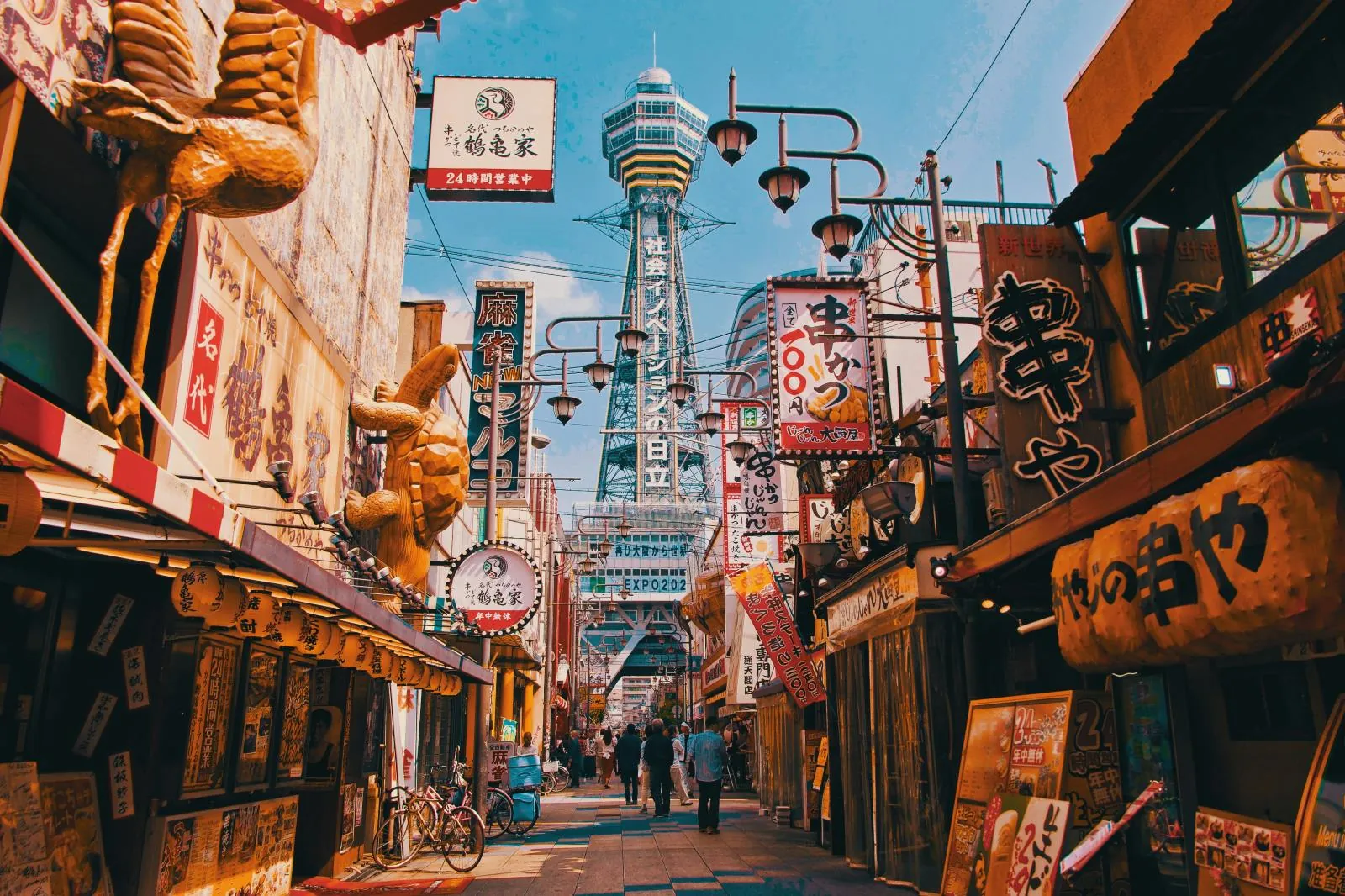
Night view of Osaka with the Dotonbori canal lit up

Kyoto or Osaka: where to stay and how to combine them

They are 15 minutes apart by Shinkansen. Choosing the right base can save you money and time.

Kyoto and Osaka are 15 minutes apart by Shinkansen and about 30 by rapid train. They are so close that many travellers wonder whether it makes sense to pay for two different accommodations, and which one to use as a base. The answer depends on what you are after in each city, your budget and how much time you have — here we compare it point by point.

Kyoto vs Osaka: character and price

KyotoOsaka
AtmosphereHistoric, traditional, calmModern, food-focused, lively
Hotel double/night90–160 €65–110 € (20–30% cheaper)
Private hostel/night60–90 €45–75 €
Temples and cultureMore than 1,600 temples in the cityOsaka Castle, Minami
FoodKaiseki, yudofu, traditional tofuTakoyaki, okonomiyaki, ramen, kushikatsu
NightlifeCalm (Gion at night)Very active (Dotonbori, Namba)
Access to Nara45 min by train (Kintetsu)45 min by train (Kintetsu/JR)
Access to Hiroshima1h 40 min Shinkansen1h 20–1h 30 Shinkansen
Booking aheadHigh (especially sakura/momiji)Medium

If your trip revolves around temples and traditional Japan: stay in Kyoto. If you want food, urban life and a lower budget: Osaka. If you go to both places and have a tight budget: Osaka as a base with day trips to Kyoto.

Advantages of staying in Kyoto

The main advantage of sleeping in Kyoto is access to the temples outside peak hours. Fushimi Inari is open 24 hours — arriving at dawn, before the groups, is only possible if you sleep nearby. Arashiyama at 7 in the morning or Higashiyama at dusk with no tourists are experiences you cannot replicate if you travel from Osaka that same day.

The Gion district also changes radically at night: the maiko walk along Hanamikoji between 17:30 and 19:00 on their way to their engagements. You only see that if you are in Kyoto at that hour.

Indicative prices: business hotel double in a tourist area (Gion, Shijo, Kyoto Station): 80–160 € / night. Ryokan with dinner and breakfast: 180–400 € / person. Prices shoot up in sakura (March–April) and momiji (November).

Advantages of staying in Osaka

Osaka is a good base if your budget is tight or if your itinerary also includes visits to other cities in the region (Kobe, Nara, Himeji). The special rapid train of the JR Kyoto Line connects Osaka Station with Kyoto Station in about 30 minutes for 580 ¥ (~3 €), and the Hankyu line does it from Osaka-umeda to Kawaramachi for about 410 ¥. Trains leave every few minutes, which makes it perfectly viable to spend the day in Kyoto and return to sleep in Osaka.

The Namba and Shinsaibashi area has a concentration of restaurants and bars with no equivalent in Kyoto. If food and nightlife are a priority, Osaka clearly wins.

Another logistical advantage: Kansai airport (KIX) is the airport for the whole region and is closer to Osaka. The JR Haruka train reaches Shin-Osaka in about 50 minutes and, without a transfer, Osaka Station; to Kyoto it takes about 75 minutes. The Nankai Rapi:t connects KIX with Namba in about 35 minutes. If you arrive late or leave early, sleeping in Osaka the first or last night simplifies the transfer.

Indicative prices: business hotel double in Namba or Umeda: 60–110 € / night. Private hostel: 45–75 €. Capsule hotel: 30–50 € / person.

The most common strategy: nights split between both

On a 10–14 day trip through Japan, the most frequent combination is to spend 2–3 nights in Kyoto and 2 in Osaka (or vice versa), and use the train to visit the other city during the day.

A popular variant: arrive in Osaka, spend 1 night, move to Kyoto for 3 nights, then go back to Osaka 1–2 nights before continuing. This lets you see Nara as a day trip from Kyoto and Kobe as a day trip from Osaka without moving accommodation.

What is not worth it: changing hotel every night between Kyoto and Osaka. Moving with luggage by train consumes time and energy. Decide on a base per area and do day trips.

Best neighbourhoods to sleep in each city

Once you have decided on the base city, the specific neighbourhood makes the difference between a comfortable trip and one with long journeys every day. These are the areas that work best:

In Kyoto

  • Higashiyama / Gion: the historic heart. You step out of the hotel and you are already among temples and traditional streets. It is the most expensive area and the one that sells out fastest in high season.
  • Shijo-Kawaramachi (centre): the best balance. Restaurants, the Nishiki market, bus lines everywhere and 10 minutes on foot from Gion. Ideal for a first visit.
  • Kyoto Station: the most practical option for arriving and leaving, and the best base if you will do daily trips (Nara, Osaka, Hiroshima) by train. Cheaper, but less neighbourhood charm.

In Osaka

  • Namba / Shinsaibashi (Minami): the centre of the atmosphere, the food and the nightlife of Dotonbori. The most popular choice. To go to Kyoto, take the metro (Midosuji) to Umeda and connect with the Hankyu line or the JR Kyoto Line; in total, about an hour door to door.
  • Umeda (Kita): a business area, department stores and the main station. Here you have the direct way to Kyoto: Hankyu (Osaka-umeda → Kawaramachi, ~410 ¥) and JR (Osaka Station → Kyoto Station, ~30 min, 580 ¥). A little quieter at night than Namba.
  • Shin-Osaka: only worth it if you prioritise the Shinkansen for getting around the country. It is the bullet-train station, with Kyoto 15 minutes away; it is not a neighbourhood for strolling, but it is unbeatable for getting in and out fast.

Once you have your route, the Plan Japan planner splits the nights between the chosen cities and links to hotels by area with prices filtered by your dates.

Plan your route through Kyoto, Osaka and the rest of Japan The planner distributes nights and budget between the cities of your itinerary.
Plan my trip

More travel guides

Frequently asked questions

Is it cheaper to stay in Osaka than in Kyoto?

Yes, by 20 to 30% on average. The difference is even greater in high season: in sakura (April) and momiji (November), Kyoto hotels can cost 40–50% more than the equivalent ones in Osaka.

Is it worth staying in Kyoto if it is so close to Osaka?

It depends on the type of trip. Sleeping in Kyoto lets you see the temples at dawn (Fushimi Inari is open 24h), see Gion at dusk and avoid journeys. If the budget is tight, Osaka as a base with a day trip to Kyoto is perfectly viable.

How long does the train from Kyoto to Osaka take?

15 minutes by Shinkansen between Kyoto Station and Shin-Osaka, a leg that the JR Pass does cover (valid for Hikari and Kodama trains; the Nozomi is excluded). See the JR Pass guide. By rapid train on the JR Kyoto Line, about 30 minutes for 580 ¥ (~3 €); on the Hankyu line, from about 410 ¥. Trains leave every few minutes.

Can you visit Kyoto and Osaka on the same day?

It does not make much sense. Both cities deserve at least a full day each. The train between them is fast, but moving with luggage or doing the route twice consumes time. The smart thing is to sleep in one and visit the other on a day trip.

Where to stay in Osaka to make it convenient for visiting Kyoto?

The most practical area is Umeda (Kita): from Osaka-umeda the Hankyu line leaves towards Kawaramachi and from Osaka Station the rapid train of the JR Kyoto Line reaches Kyoto in about 30 minutes. From Shin-Osaka you have the Shinkansen to Kyoto in 15 minutes (covered by the JR Pass). Namba is great for the atmosphere, but for Kyoto it is best to go up to Umeda first and connect there.

When should you book hotels in Kyoto?

In normal season, 4–6 weeks ahead is enough. In sakura (late March–early April) and momiji (November), book 3–4 months ahead. See when to visit Kyoto for the exact dates of each season.

Is it safe to stay in Osaka to visit Kyoto with children?

Perfectly. The train is comfortable, punctual and safe. With small children who need more breaks, staying in Kyoto may be better to avoid the daily journey. If the children are over 8–10, Osaka works well as a base for the whole region.