
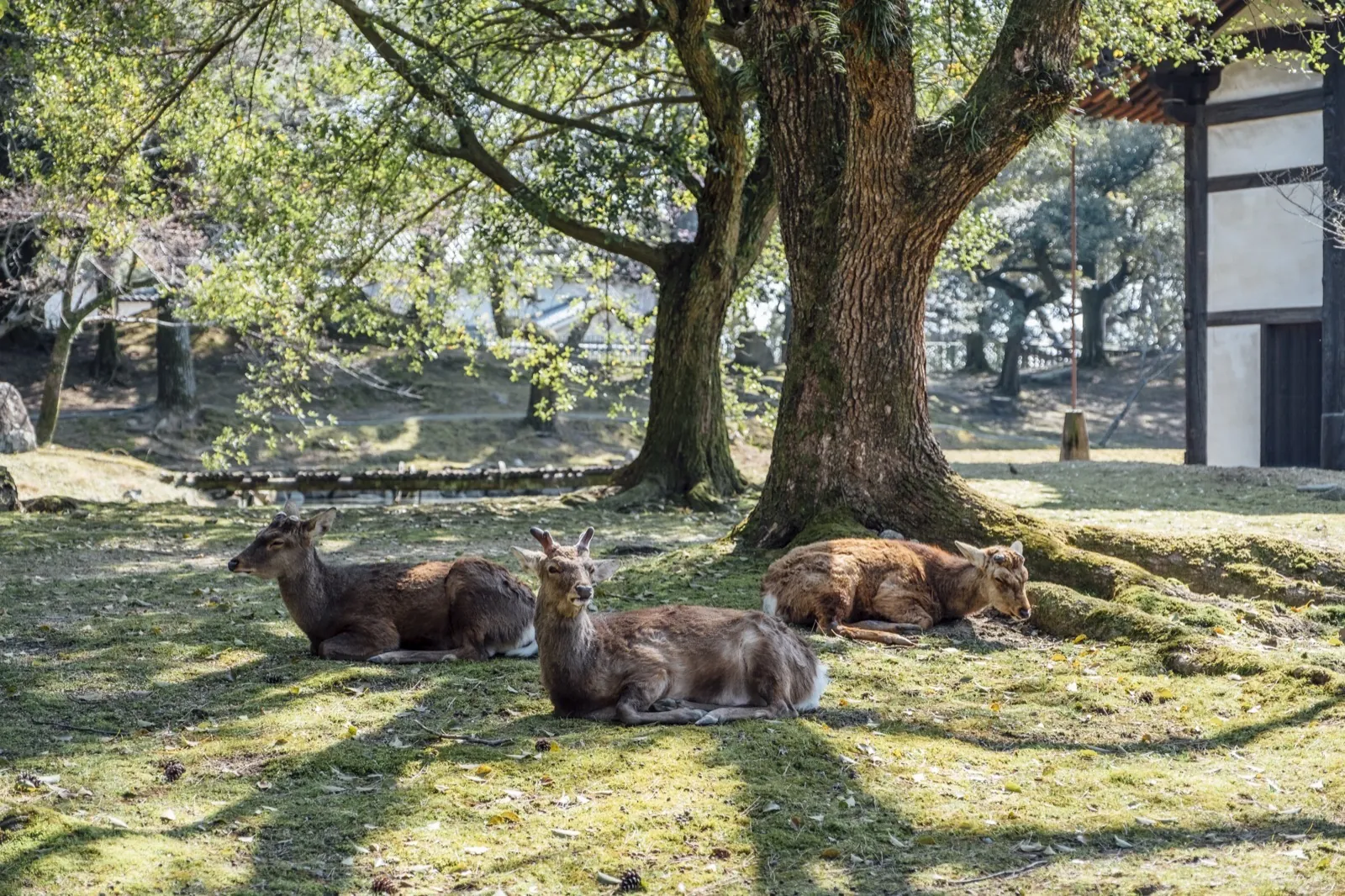
Deer in Nara park next to a temple

Day trip to Nara from Kyoto

45 minutes away by train: free-roaming deer, the largest Buddha in Japan and one of the most beautiful historic parks in the country.

Nara was the first permanent capital of Japan (710–784 AD) and preserves an exceptional monumental ensemble: Todai-ji temple with the largest bronze Great Buddha in the world, the Kasuga shrine with its thousands of stone lanterns, and a park where more than 1,200 deer live freely among the monuments.

How to get to Nara from Kyoto

There are two companies that connect Kyoto with Nara, and the choice depends above all on whether you have a JR Pass:

JR Nara Line (the best option with a JR Pass)

It leaves from Kyoto Station to JR Nara Station. The rapid Miyakoji train takes about 45 minutes and costs 720 ¥ (~3.9 €); it runs roughly every 30 minutes. It is covered by the JR Pass. The local trains cost the same but take about 75 minutes, so it is worth making sure you take the rapid one.

Kintetsu (closer to the park)

It leaves from Kintetsu-Kyoto Station (attached to Kyoto Station) to Kintetsu Nara Station, which is closer to the park than the JR one (it saves you 5–10 minutes on foot). There are two types:

  • Limited Express (tokkyu): about 35 minutes, but on top of the base ticket (760 ¥) you have to add a reserved-seat supplement (520 ¥), so the total is around 1,280 ¥ (~7 €). Not covered by the JR Pass.
  • Express (no surcharge): about 45 minutes for 760 ¥ (~4.1 €), with no supplement. Also not included in the JR Pass.

In short: with a JR Pass, use the JR Nara Line (it is free for you). Without a JR Pass, the Kintetsu drops you closer to the park; the limited express saves about 10 minutes in exchange for the supplement, while the regular express costs practically the same as the JR.

The deer: the first thing you will see on arrival

The more than 1,200 deer (shika) that live in Nara Park are protected wild animals considered divine messengers of the Kasuga shrine. They walk freely through the park, the streets of the centre and around the temples.

They are gentle and used to tourists, but they are not pets. They bite bags, maps and anything that looks edible. The shika senbei (deer crackers) are sold at 200 ¥ a pack at several stalls in the park — if you buy them, you will be surrounded by deer in seconds.

Some deer have learned to bow to ask for food. It is not training: they have copied it from the humans who bow to them.

What to see in Nara in a day

Todai-ji and the Great Buddha

The most important temple in Nara. It houses the Daibutsu, a bronze Buddha about 15 metres tall cast in the 8th century — the largest bronze Buddha in the world. The wooden building that contains it (Daibutsuden) is among the largest wooden structures on the planet. Entry to the Daibutsuden: 800 ¥ (~4.3 €). Open 7:30 to 17:30 (April to October) and 8:00 to 17:00 (November to March).

Kasuga Taisha shrine

The most important Shinto shrine in Nara, founded in 768. It is famous for its more than 3,000 bronze and stone lanterns donated over the centuries, which are lit twice a year (Setsubun in February and Obon in August). Access to the outer grounds is free; the inner area costs 700 ¥ (~3.8 €) and is open 9:00 to 16:00.

Kofuku-ji

A Buddhist temple with a five-storey pagoda from the 8th century (rebuilt, like most of Nara, several times). It is at the entrance to the park, a few minutes from the station. Free access to the exteriors; some halls have a separate entry.

A walk through Nara Park

The park itself deserves time: the deer among the stone lanterns on the way to Kasuga, the view of Sarusawa pond with the Kofuku-ji pagoda in the background and the Isuien gardens (entry 1,200 ¥, ~6.5 €), one of the most beautiful landscape gardens in Japan. Nara is among the essentials of any route through the country; see what to see in Japan to fit it in with the rest.

Suggested itinerary for a day in Nara

TimeActivityNotes
09:00Departure from KyotoJR Nara Line from Kyoto Station (platform 8)
09:45Arrival in NaraWalk along Sanjo-dori towards the park (~15 min)
10:15Todai-jiArrive before the tour groups. Entry 800 ¥
11:30Park + deer + Kofuku-jiBuy deer crackers (200 ¥). Kofuku-ji exterior free
13:00Lunch in NaramachiKakinoha-zushi (sushi in persimmon leaf, a local dish), 10–15 €
14:30Kasuga Taisha shrineExterior free; inner area 700 ¥
15:30Isuien gardens (optional)An exceptional Japanese garden. Entry 1,200 ¥
16:30–17:00Return to KyotoJR Nara Line from Nara Station

How much the trip to Nara costs

  • Return train Kyoto ↔ Nara~8 € (included in the JR Pass)
  • Todai-ji entry4.3 €
  • Kasuga shrine interior (optional)3.8 €
  • Isuien gardens (optional)6.5 €
  • Lunch (kakinoha-zushi or another local dish)10–15 €
  • Deer crackers (essential)1.1 €
  • Total without JR Pass23–39 €
  • Total with JR Pass15–31 €

Indicative amounts converted from yen. For the exact day's equivalent use the yen converter.

Practical tips to make the most of the day

Etiquette with the deer

  • Show your empty hands when you have no crackers left: the deer understand the gesture and move away.
  • Keep paper maps, tickets and food in a closed bag: they bite anything sticking out of a pocket.
  • During the rutting season (October-November) the stags have antlers and are rougher; keep your distance with small children.

How to avoid the crowds

Todai-ji fills with groups from 10:30. If you leave Kyoto at 8:00–8:30 and go in as soon as it opens, you will see it much quieter. The crackers from the stalls near Todai-ji and Kofuku-ji concentrate the most besieged deer; those at the far end towards Kasuga are more relaxed.

If you have time to spare or come back for a second day

  • Naramachi: the old merchant quarter, with wooden houses (machiya), cafes and craft shops. Perfect for after lunch.
  • Mount Wakakusa: a grassy hill behind the park with panoramic views of the city; a short walk.
  • Horyu-ji: about 20 minutes by train, it houses the oldest wooden buildings in the world (a World Heritage Site). For a second visit or those after something off the circuit.

Fit Nara in as a day within a 10-day itinerary or 14-day itinerary: it counts as a full day and it is best not to chain it with another trip right after.

Include Nara in your itinerary through Japan The planner splits the days between Kyoto, Nara and the rest of the cities to fit your budget.
Plan my trip

More travel guides

Frequently asked questions

Is it worth going to Nara from Kyoto?

Yes, it is one of the best day trips in Japan. Free-roaming deer, the largest bronze Great Buddha in the world and an exceptional historic park 45 minutes by train from Kyoto, with cheap entries and an authentic city that does not feel crowded.

Does the JR Pass cover the train to Nara from Kyoto?

Yes, the JR Nara Line (45 min, 720 ¥) is covered by the JR Pass. The Kintetsu line (closer to the park: 760 ¥ on the 45-min express, or 1,280 ¥ on the 35-min limited express) is not included in the JR Pass.

Are the Nara deer dangerous?

They are not dangerous, but they are wild animals. They can bite bags that smell of food, and during the breeding season (October-November) the antlered stags can be more assertive. You should not corner them or make abrupt gestures at them. Deer crackers are sold at stalls in the park (200 ¥).

Can you do Nara and Kyoto in the same day from Tokyo?

Doing it all from Tokyo in a single day is too much: it would be 4–5 hours of train plus the time in each city. The smart thing is to stay in Kyoto 2–3 nights and do Nara as a day trip. See how many days to spend in Kyoto.

How much time do you need to visit Nara?

With half a day (4–5 hours) you see Todai-ji, the park with the deer and Kofuku-ji. With a full day you can add Kasuga Taisha, the Isuien gardens and the historic Naramachi district.

Can you also go to Nara from Osaka?

Yes. From Osaka the Kintetsu Rapid Express goes from Osaka Namba to Kintetsu Nara in about 36 minutes for 680 ¥ (the limited express takes a few minutes less but costs around 1,300 ¥). The JR Yamatoji Line also links the two cities and is included in the JR Pass. Nara is just as convenient as a day trip from Osaka as from Kyoto.

When is the best time to visit Nara?

In spring (sakura in March-April) and autumn (momiji in November) the park is especially beautiful. Summer is hot. In winter it has very few people and if it snows the image of the deer in the snow is exceptional. See when to travel to Japan to choose the best time.